ESP32-S3-EYE
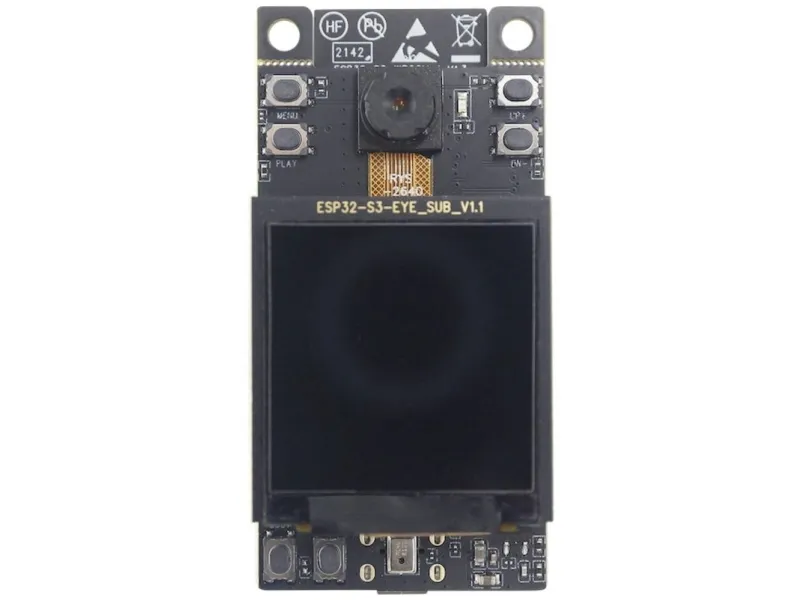
The ESP32-S3-EYE is a compact AI development board created by Espressif, based on the ESP32-S3 SoC and the ESP-WHO AI development framework. This board is equipped with a 2-Megapixel camera, an LCD display, and a microphone, making it suitable for image recognition and audio processing tasks.
Key Features
- Camera: The board features an OV2640 camera with 2 million pixels, a 66.5° field of view, and a maximum resolution of 1600×1200. The resolution can be adjusted during application development.
- LCD Display: A 1.3” LCD display connected to the ESP32-S3 over the SPI bus.
- Microphone: A digital I2S MEMS microphone with 61 dB SNR and –26 dBFS sensitivity.
- Storage: It includes 8 MB Octal PSRAM and 8 MB flash for ample storage.
- Connectivity: Supports image transmission via Wi-Fi and debugging through a Micro-USB port.
- Power Supply: The board can be powered via USB or an external Li-ion battery.
Components
Main Board (ESP32-S3-EYE-MB)
- ESP32-S3-WROOM-1 Module: Provides Wi-Fi and Bluetooth 5 (LE) connectivity, with dedicated vector instructions for neural network computing and signal processing.
- MicroSD Card Slot: Allows for memory expansion.
- Battery Charger Chip: A 1 A linear Li-ion battery charger.
- Accelerometer: A three-axis accelerometer for screen rotation.
Sub Board (ESP32-S3-EYE-SUB)
- LCD Display: 1.3” LCD display connected via SPI bus.
- Strapping Pins: Four strapping pins for testing.
Getting Started
To get started with the ESP32-S3-EYE, you need the following hardware:
- ESP32-S3-EYE Board
- USB 2.0 Cable (Standard-A to Micro-B)
- Computer running Windows, Linux, or macOS
Hardware Setup
- Connect the board to the computer using the USB cable. The Module Power LED should turn on.
- Ensure the board is in good condition with no visible damage.
Software Setup
- Get ESP-IDF: Provides a common framework to develop applications for ESP32-S3 in C language.
- Get ESP-WHO: An image processing platform that runs on ESP-IDF.
- Run Examples: Provided by ESP-WHO.
Application Development
The ESP32-S3-EYE can be used to develop various AIoT applications such as smart doorbells, surveillance systems, and facial recognition time clocks. The board comes with pre-built default firmware that allows you to test its functions, including voice wake-up, voice command recognition, face detection, and recognition.
Important Considerations
- GPIO Allocations: Except for GPIO3, all GPIOs are used to control specific components.
- Independent Power Supplies: The board features independent power supplies for the camera and other components to reduce noise and improve performance.
For more detailed information, you can refer to the ESP32-S3-EYE Getting Started Guide.